Chronograph - Watch
Find Best & New Watches
 A chronograph is a timepiece or watch with both timekeeping and stopwatch functions. Pocket watch chronographs were produced as early as the 18th century but did not become popular until the 1820s. The term 'Chronograph' is often confused with the term 'Chronometer' which in some cases designates a watch that has received a precision certification. The Marine chronometer was an accurate timepiece used to enable celestial navigation.
There are many types of chronographs.
* Digital chronographs use a digital display for both timekeeping and stopwatch functions, either with separate displays or by switching modes on a single display.
* Analog-digital chronographs have a standard analog watch with permanent center seconds and a separate digital display that usually operates independently of the analog section. A fallback will reset to zero and then continue to run when the reset button is pushed while the stopwatch is running. In contrast, most mechanical chronographs will reset to zero only when the stopwatch is stopped.
A chronograph is a timepiece or watch with both timekeeping and stopwatch functions. Pocket watch chronographs were produced as early as the 18th century but did not become popular until the 1820s. The term 'Chronograph' is often confused with the term 'Chronometer' which in some cases designates a watch that has received a precision certification. The Marine chronometer was an accurate timepiece used to enable celestial navigation.There are many types of chronographs.
* Digital chronographs use a digital display for both timekeeping and stopwatch functions, either with separate displays or by switching modes on a single display.
* Analog-digital chronographs have a standard analog watch with permanent center seconds and a separate digital display that usually operates independently of the analog section. A fallback will reset to zero and then continue to run when the reset button is pushed while the stopwatch is running. In contrast, most mechanical chronographs will reset to zero only when the stopwatch is stopped.
 A


 Watches may be crafted to become water resistant. These watches are sometimes called diving watches when they are suitable for scuba diving or saturation diving. The International Organization for Standardization issued a standard for water resistant watches which also prohibits the term "waterproof" to be used with watches, which many countries have adopted. Water resistance is achieved by the gaskets which form a watertight seal, used in conjunction with a sealant applied on the case to help keep water out. The material of the case must also be tested in order to pass as water resistant.
 Zero gravity environment and other extreme conditions encountered by astronauts in space requires the use of specially tested watches. On April 12, 1961, Yuri Gagarin wore a Shturmanskie (Штурманские > navigator's) wristwatch during his historic first flight into space. The Shturmanskie was manufactured at the First Moscow Factory.


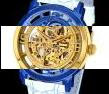 Traditionally, watches have displayed the time in analog form, with a numbered dial upon which are mounted at least a rotating hour hand and a longer, rotating minute hand. Many watches also incorporate a third hand that shows the current second of the current minute. Watches powered by quartz usually have a second hand that snaps every second to the next marker.
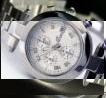 Automatic quartz is a collective term describing watch movements that combine a self-winding rotor mechanism (as used in automatic mechanical watches) to generate electricity with a piezoelectric quartz crystal as its timing element. Such movements aim to provide the advantages of quartz without the environmental impact of batteries. Several manufacturers employ this technique.
 mainspring of a mechanical movement by the natural motions of the wearer's body. The first self-winding mechanism, for pocketwatches, was invented in 1770 by Abraham-Louis Perrelet; but the first "self-winding," or "automatic," wristwatch was the invention of a British watch repairer named John Harwood in 1923. This type of watch allows for a constant winding without special action from the wearer: it works by an eccentric weight, called a winding rotor, which rotates with the movement of the wearer's wrist.
 source. In manual watches the spring must be rewound by the user periodically by turning the watch crown. Antique pocketwatches were wound by inserting a separate key into a hole in the back of the watch and turning it. Most modern watches are designed to run 40 hours on a winding, so must be wound daily, but some run for several days and a few have 192-hour mainsprings and are wound weekly.
 Watch, Electronic movements have few or no moving parts, as they use the piezoelectric effect in a tiny quartz crystal to provide a stable time base for a mostly electronic movement. The crystal forms a quartz oscillator which resonates at a specific and highly stable frequency, and which can be used to accurately pace a timekeeping mechanism. For this reason, electronic watches are often called quartz watches. Most quartz movements are primarily electronic but are geared to drive mechanical hands on the face of the watch in order to provide a traditional analog display of the time, which is still preferred by most consumers.
 Compared to electronic movements,
